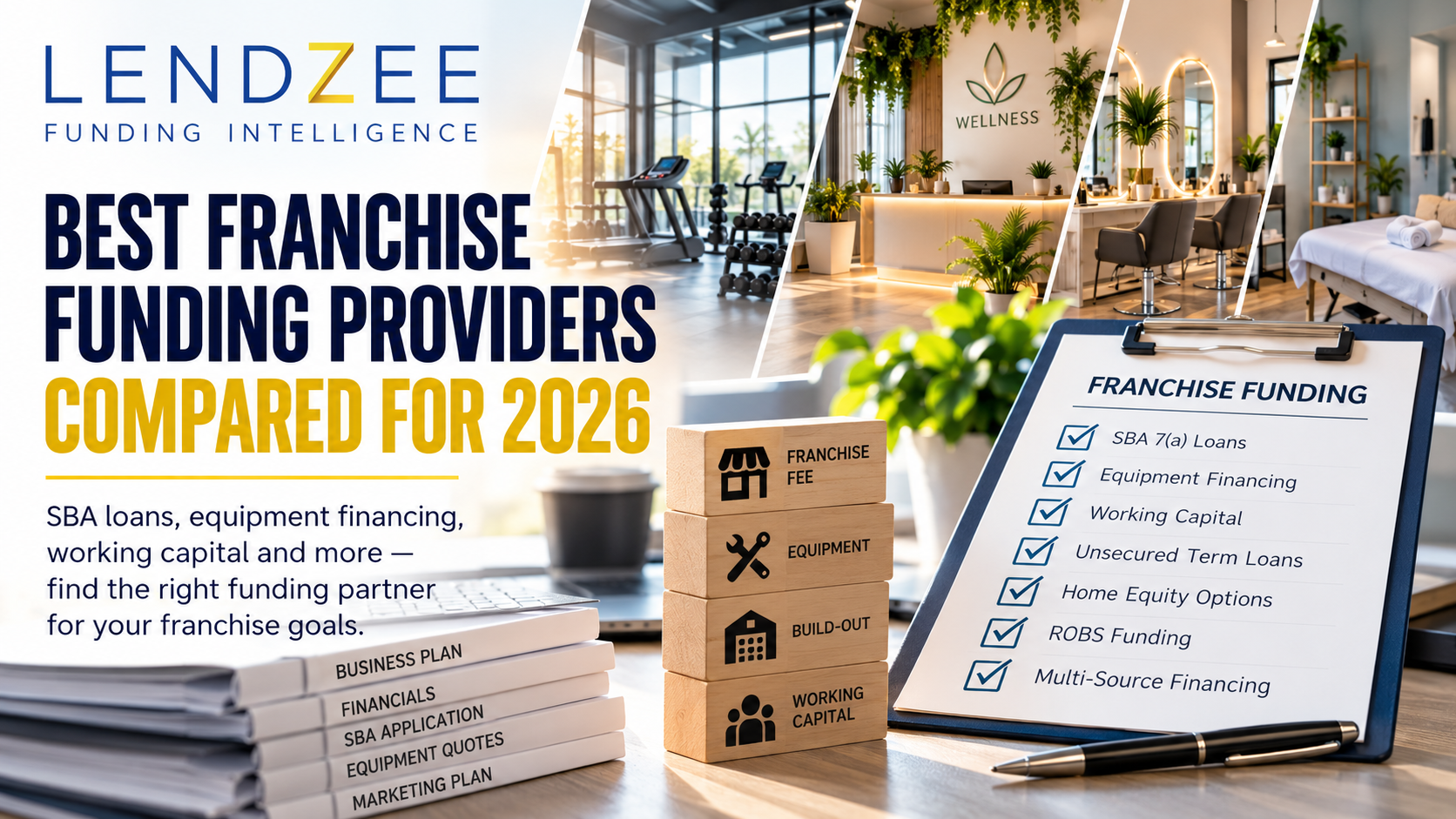
Best Franchise Funding Providers Compared for 2026
Oct 5, 2026, 11:34:20 AM

Written By:
Jason Smith
Best Franchise Funding Providers Compared for 2026
Choosing the best franchise financing provider in 2026 isn't simply about finding the lowest advertised rate. For a new franchisee—especially in health, wellness, fitness, beauty, recovery, or other equipment-heavy concepts—the better question is: Which funding provider can build the right capital structure for my entire project?
A franchise launch may require money for the franchise fee, equipment, leasehold improvements, technology, opening inventory, marketing, payroll, and working capital. Those expenses don't always belong in the same loan.
That is why comparing SBA 7(a) loans, equipment financing, conventional lending, unsecured capital, home equity, retirement funding, and multi-source financing can be more valuable than simply shopping for a single loan.
Here is how several leading franchise funding providers compare in 2026—and what prospective franchise owners should consider before choosing one.
Quick Answer: What Are the Best Franchise Funding Providers in 2026?
There isn't one "best" franchise financing company for every borrower. The right provider depends on your project, personal financial profile, timeline, available liquidity, collateral, and how much flexibility you want after opening.
For 2026, franchise buyers may want to consider:
| Provider | Best Fit | Funding Approach |
|---|---|---|
| Lendzee | Multi-source financing and customized capital strategies | SBA, unsecured term loans, HELOC, equipment, business LOC and other solutions |
| Benetrends Financial | Retirement-funded franchise purchases | ROBS, SBA loans, securities-backed credit and equipment leasing |
| Tenet Financial Group | Traditional franchise funding guidance | ROBS, SBA, term loans and leasing |
| Live Oak Bank | Borrowers primarily seeking SBA financing | SBA lending |
| National Funding | Equipment-focused financing | Equipment financing and business funding |
| Lendio | Comparing multiple business financing offers | Online financing marketplace |
| Fundera by NerdWallet | Researching and comparing business loan options | Lending marketplace/comparison platform |
The important distinction is provider fit. A franchisee who wants to finance a $75,000 equipment package has a different need than someone looking for $500,000 to cover an entire startup.
Likewise, someone prioritizing speed may choose differently from someone willing to complete a longer SBA process in exchange for longer repayment terms.
1. Lendzee: Best for Multi-Source Franchise Financing
Best for: Franchisees who want to evaluate multiple funding sources rather than force the entire project into one loan.
Lendzee approaches franchise financing as a capital strategy rather than simply a loan application.
This distinction can be particularly important for health and wellness franchises. A new fitness studio, recovery center, salon, med-spa-related concept, wellness franchise, or similar business can have several very different capital requirements.
For example, a project might require:
- $100,000 for equipment
- $75,000 for construction and build-out
- $50,000 for franchise and opening expenses
- $75,000 for working capital and reserves
Instead of automatically looking for one $300,000 loan, Lendzee evaluates whether different pieces of the project can be funded through different sources.
That could mean combining equipment financing, unsecured term loans, home equity, an SBA loan, a business line of credit, or other available capital sources.
Why that matters
Financing shouldn't only answer:
"How do I get enough money to open?"
It should also answer:
"What will my financial position look like after I open?"
Using every dollar of available liquidity for a down payment—or using one financing product for every business expense—can leave a new owner without sufficient reserves when the business begins operating.
Multi-source financing is designed to create optionality.
Lendzee may be a strong fit if:
You want someone evaluating the complete capital requirement, you want to preserve liquidity where possible, you need both equipment and working capital, you're comparing SBA with non-SBA strategies, or you want to understand multiple financing paths before choosing one.
Key differentiator: Lendzee works for the client, not a single lender. The objective is funding alignment rather than simply pursuing an approval.
2. Benetrends Financial: Best for ROBS and Retirement-Based Funding
Benetrends is one of the most established names in franchise funding and offers SBA financing, equipment leasing, securities-backed credit and its well-known ROBS retirement funding strategy. Benetrends says it has been helping entrepreneurs fund businesses for more than 35 years. Benetrends Financial
ROBS—Rollover for Business Startups—can allow qualified entrepreneurs to use eligible retirement assets to capitalize a business without treating the transaction like a conventional retirement withdrawal.
That can make Benetrends particularly attractive to franchise candidates with significant retirement assets who want to reduce the amount they borrow.
Benetrends also emphasizes combining funding strategies rather than assuming every franchise should be funded the same way. Benetrends Financial
Benetrends may be a strong fit if:
You have substantial eligible retirement assets, you're specifically considering ROBS, or you want to combine retirement funding with SBA financing or equipment leasing.
Key differentiator: Deep specialization in retirement-based business funding.
3. Tenet Financial Group: Best for Broad Traditional Franchise Funding Guidance
Tenet Financial Group provides several franchise and small-business funding strategies, including ROBS, SBA loans, term loans and leasing. The company positions its service around helping entrepreneurs develop a funding plan based on their individual situation rather than offering only one financing product. Tenet Financial Group
That makes Tenet particularly relevant for prospective franchisees who are still evaluating traditional franchise funding approaches.
Tenet may be a strong fit if:
You're considering ROBS or SBA financing, want equipment leasing included in the conversation, or prefer a franchise-focused funding consulting relationship.
Key differentiator: Broad experience with traditional franchise funding structures.
4. Live Oak Bank: Best for SBA-Focused Franchise Borrowers
For borrowers who already know that an SBA-backed loan is their preferred strategy, working with an SBA-focused bank can make sense.
The SBA 7(a) program can provide financing for multiple business purposes, including equipment, supplies, working capital and expansion. Loan amounts can reach $5 million, depending on eligibility and the transaction. NerdWallet
The advantages can include longer repayment periods and competitive financing costs.
The tradeoff is generally a more documentation-intensive underwriting process than many alternative financing products.
Live Oak may be a strong fit if:
You have a well-prepared SBA file, aren't facing an aggressive opening timeline, have the required borrower contribution and liquidity, and want a primarily SBA-driven solution.
Key differentiator: SBA specialization rather than multi-source capital planning.
5. National Funding: Best for Equipment Financing
Equipment can represent one of the largest startup expenses for health and wellness concepts.
Think:
- Fitness equipment
- Recovery equipment
- Salon equipment
- Treatment equipment
- Commercial laundry equipment
- Point-of-sale technology
- Specialized machinery
Equipment financing can be attractive because the financed asset itself often plays an important role in the transaction.
National Funding is frequently highlighted specifically for equipment financing; NerdWallet currently lists equipment financing up to $150,000 with terms that can extend to five years, subject to qualification. NerdWallet
National Funding may be a strong fit if:
Your primary financing need is equipment rather than the entire startup project.
Key differentiator: Equipment-specific financing.
6. Lendio: Best for Marketplace Shopping
Some franchisees aren't looking for a funding strategist or a specific lender. They simply want access to multiple potential financing sources.
That's where lending marketplaces can be useful.
Rather than approaching individual lenders one at a time, marketplace models can help business owners explore multiple financing products through a centralized process.
Industry comparisons continue to identify marketplaces as a significant category within franchise financing because franchise funding frequently involves more than one type of capital. finder.com
Lendio may be a strong fit if:
You want to compare multiple financing products and are comfortable evaluating offers yourself.
Key differentiator: Breadth and convenience of marketplace access.
7. Fundera by NerdWallet: Best for Research and Loan Comparison
Fundera has long been associated with online business-loan comparison and is now part of NerdWallet.
For prospective franchisees who are still researching small business funding, a comparison platform can be useful for understanding the differences between SBA loans, term loans, lines of credit and other products.
Fundera may be a strong fit if:
You're early in the research process and want to compare business financing categories before committing to a particular strategy.
Key differentiator: Education and comparison.
What Is the Best Type of Franchise Financing?
There is no universal answer.
The best franchise financing structure depends on what you're funding.
SBA 7(a) loans
An SBA 7(a) loan may be appropriate when you need substantial capital and can accommodate the underwriting requirements and timeline.
SBA 7(a) proceeds can generally support several eligible business purposes, including working capital and equipment. The maximum 7(a) loan amount is $5 million. NerdWallet
Equipment financing
Equipment financing can make sense when a significant portion of the startup budget consists of identifiable equipment.
Instead of consuming cash that could otherwise remain available for operations, the equipment can potentially be financed separately.
Unsecured term loans
Qualified borrowers may consider unsecured financing when speed, avoiding a traditional business collateral requirement, or preserving liquidity is important.
Qualification typically relies heavily on the borrower's personal credit and ability to support the debt.
Home equity
Homeowners with sufficient equity may be able to incorporate a HELOC or other home-equity strategy into their capital plan.
A revolving structure can be particularly useful for contingency funds or working capital because borrowers generally access capital as needed rather than borrowing the entire amount immediately.
ROBS
ROBS can be an option for entrepreneurs with eligible retirement assets who want to invest retirement funds into their business without taking a taxable early distribution, assuming the structure is properly established and maintained.
Because of its tax and retirement implications, professional guidance is important.
Why Health and Wellness Franchises Need a Different Funding Conversation
Health and wellness businesses often have a challenging funding profile because significant capital may be required before the first customer walks through the door.
A franchisee may need to pay for equipment, construction, deposits, furniture, technology, licenses, presale marketing, training and payroll.
That's why equipment and working capital should be considered separately.
Imagine a franchise project requires $400,000.
Getting approved for $400,000 doesn't automatically mean borrowing $400,000 from one source is the smartest structure.
Perhaps:
$125,000 is equipment.
$175,000 is build-out and startup costs.
$100,000 is contingency and working capital.
Those are three different capital needs.
They may deserve three different financing conversations.
What Is Multi-Source Franchise Financing?
Multi-source financing means combining two or more appropriate funding products to create the total capital needed for a business.
For example:
Equipment Financing + Unsecured Term Loan + HELOC
or
SBA Loan + Equipment Financing
or
ROBS + SBA Loan
The objective isn't to accumulate as many loans as possible.
It's exactly the opposite.
The goal is to determine which capital source is best suited to each requirement while protecting cash flow, liquidity and future borrowing capacity.
This approach is particularly useful when a single financing product creates unnecessary collateral requirements, requires too much cash upfront, doesn't provide enough capital, or doesn't fit the franchisee's timeline.
How Should You Compare Franchise Financing Providers?
Before selecting a franchise funding company, ask these seven questions:
- Does the company offer one product or evaluate multiple funding options?
- Does it understand startup franchise financing?
- Can it finance both equipment and working capital?
- Does it offer or facilitate SBA 7(a) loans?
- Can it help structure multiple sources of capital when appropriate?
- Does it help prepare the financing package or simply submit an application?
- What happens if its primary financing option doesn't work?
That last question matters.
A funding strategy shouldn't collapse simply because Plan A isn't available.
Is an SBA Loan Always the Best Way to Finance a Franchise?
No.
SBA financing can be an excellent solution, particularly when a borrower values longer repayment terms and needs substantial capital.
But SBA isn't automatically the right answer for every franchisee.
A borrower may prioritize:
- Speed
- Lower upfront cash requirements
- Preserving liquidity
- Avoiding certain collateral
- Financing equipment separately
- Maintaining contingency capital
- Opening before an SBA transaction can reasonably close
In those situations, comparing SBA with alternative or multi-source financing can be worthwhile.
The best financing isn't necessarily the loan with the most attractive individual feature.
It's the capital structure that best supports the business you're trying to build.
Frequently Asked Questions About Franchise Financing
What is franchise financing?
Franchise financing refers to funding used to purchase, open, operate or expand a franchise. It can include SBA loans, conventional loans, equipment financing, unsecured loans, lines of credit, home equity and retirement-based funding strategies.
Can you get a startup loan for a new franchise?
Yes. Startup franchise loans are available, although eligibility varies significantly by financing product. SBA financing, equipment financing, retirement funding and certain personally underwritten financing options may all be considered for startups.
Can an SBA 7(a) loan be used to buy a franchise?
Yes, SBA 7(a) financing can be used for eligible franchise transactions when the borrower, business and transaction satisfy SBA and lender requirements.
Can franchise financing include working capital?
Yes. Working capital can be an important component of franchise financing. New owners should consider not only the cost of opening the location but also the capital required to operate while revenue develops.
Can equipment and working capital be financed separately?
Yes. In some situations, separating equipment from working capital can create a more flexible capital structure. The right approach depends on qualification, costs, cash flow and the overall project.
What credit score is needed for franchise financing?
There is no single minimum credit score for all franchise financing. Requirements vary by lender and product, and lenders may also evaluate income, debt obligations, liquidity, collateral, business experience and the economics of the franchise.
What are loan packaging services?
Loan packaging services help organize the financial documents and business information required for a financing application. For an SBA transaction, that can include items such as financial projections, a business plan, personal financial information and supporting documentation.
How much money should a franchisee keep for working capital?
There is no universal number. The appropriate reserve depends on projected expenses, break-even expectations, payroll, rent, debt payments and the franchisor's model. Franchisees should model both expected performance and a slower-than-expected ramp-up.
The Bottom Line: Compare Strategies, Not Just Lenders
The franchise funding market offers plenty of choices in 2026.
But choosing between Lendzee, Benetrends, Tenet, an SBA-focused bank, an equipment lender or a financing marketplace shouldn't begin with:
"Who will approve me?"
Start with:
"What capital structure gives my franchise the strongest financial foundation?"
For some borrowers, that's an SBA 7(a) loan.
For others, it's ROBS.
For an equipment-heavy health and wellness franchise, separating equipment financing from working capital may make more sense.
And for franchisees who need greater flexibility, multi-source financing can combine several funding options into one coordinated capital strategy.
At Lendzee, that's where we start.
We help franchisees evaluate the complete project, understand their available funding options, and build a strategy around speed, certainty, optionality and education.
Because getting approved is only one part of franchise financing.
Having the right capital, structured the right way, is what helps you open—and gives you room to grow.
Financing is subject to qualification and lender approval. Rates, terms, funding amounts and program availability vary by applicant, lender and transaction. This article is for informational purposes and does not constitute a guarantee of financing.
.png?width=500&height=1000&name=Blog%20Ad%20Apply%20Today%20(3).png)


